
Interview - Mike Scott of the Waterboys - 21st May 2026
Mike Scott - image supplied
It has been over a decade since The Waterboys have ventured south to the Antipodes to play shows in New Zealand. This week the band is playing long-awaited shows in Wellington and Auckland — shows that will feature songs from across their five-decade-long career, including music from their latest album, Life, Death and Dennis Hopper, as well as the hits that continue to resonate across generations. Ahead of the band’s shows in Aotearoa I caught up with Mike Scott, frontman, guitarist, songwriter and founding member of The Waterboys, to chat about the band’s longevity, revisiting the past, and finding inspiration in unexpected places.
Interview By: Bridget Herlihy
Interviewee: Mike Scott
Date: 21st May 2026
It's been over a decade since you were last visited Australia, and even longer since The Waterboys were last in New Zealand. Are you looking forward to coming back?
Yes, absolutely. It has been partly due to the pandemic, which knocked everybody out for several years. And it's expensive for us to get across the world, but we're playing nice venues, and our tickets have been doing well. But we don't do such great business that it becomes dead easy for us to tour. It's hard to make ends meet financially. It’s an expensive thing to do. With everything that's going on in the Middle East, the cost of fuel and travel is skyrocketing, and we had to change all our flights. We were meant to be flying through Dubai, and we had to change all our flights, which was expensive.
We are very excited to have you back down under. I recently read an article that stated that even after five decades, The Waterboys are still considered to be one of the best live bands on the planet. In the past you have spoken about the band improvising on stage; do you think that is part of the band’s enduring reputation as one of the most beloved live acts?
I think it probably is, yeah. We improvise on stage and we don't play the songs the same way every night. And stuff happens; stuff that's unexpected happens, so the music takes off. I went to a concert with my daughter. I went to see Renee Rapp, who's a popular singer. It was absolutely brilliant. I got the feeling it's probably very similar each night, and that's OK. But it's just not what I do on stage. I like to keep changing it. Everything evolves in the moment. When I sing a song, I like being in the moment and singing it, depending on how I'm feeling.
Are there any other newer artists that you find particularly interesting or have captured your attention over the last couple of years?
I went through a period of liking Taylor Swift a lot, again through my daughter. You see, I hear all the young artists through my daughter. She loves all the girl singers like Tate McRae and Olivia Rodrigo, Sabrina Carpenter and so on. I hear all of them, and generally I like them. And she's also started listening to rap now. I've heard plenty of rap over the years, but it's interesting listening to what she likes. It's a real sort of extra education that I wasn't expecting.
In your own right you have had a lengthy and remarkable career, releasing 16 albums with The Waterboys as well as a solo career. I mean, you're 16 albums into The Waterboys. You have mentioned in the past that you don't really separate The Waterboys' work from your solo work, whereas some artists draw a line in the sand, with distinctly different sounds and moods for different projects.
No, no, of course not, no. For me, the solo thing was just something that I tried out. I made an album where I played every instrument myself, and I thought, ‘I'll just put this out under my own name.’ The Waterboys had broken up; there was no band at the time. It felt like a good step. Then I followed it with a more rock and roll album with bass, drums and other musicians. And because I'd signed a record deal as Mike Scott for two albums, I did the second album as Mike Scott as well, but I had a band then. It was really weird. I didn't want to have a band under the name Mike Scott. I felt like it should have been The Waterboys. So I thought, ‘I'm never going to do that again.’
It must have been quite a lengthy process of recording every instrument yourself.
Well, I've done that so many times over the years. Most people of my generation have done a bit of that, because with the technology there, it's easy to do. I suppose when Paul McCartney did it on his first solo album it was a bit of a frontier. But for me in the early ‘80s, playing all the instruments myself, it was just something that people could do; something that you needed to do. And being a multi-instrumentalist, perhaps not as common now as it may have been back then.
Your latest album under the moniker of The Waterboys, Life, Death and Dennis Hopper, is a superb piece of work. How did the concept for that album come about?
Well, I was interested in Dennis because I knew about him. I knew him as the guy from Easy Rider and Apocalypse Now. I knew he'd been in Rebel Without A Cause and various other movies. One day I was in London and I was walking down the street and I passed an art gallery. There was a poster in the window for something called The Lost Album by Dennis Hopper. I thought, ‘What is that?’ Lost album — it sounded like it was music. Dennis Hopper, he was an actor. What was all this? So I went in and it turned out that it was his photography, and I didn't know he was a brilliant photographer. His pictures were all from 1961 to ‘67, which was a particularly powerful and significant time culturally. They were all taken in America; there were the film stars of the era and his friends and the new rock and roll superstars like Buffalo Springfield, The Grateful Dead, Ike and Tina Turner, and all captured so beautifully. He had a real eye for photography and I think he captured people's souls as well. So that made me interested in Dennis Hopper, the man. So I started reading everything I could about him. I found a book collecting together his interviews over the years from when he was a new contract actor in the mid-’50s right through to close to his death. And I read a couple of biographies of him. I did a lot of background research because I found him so fascinating.
Which aspects of him and work did you find the most fascinating?
Well, two things, I suppose. His character, and then secondly, that he was present in so many crucial cultural moments. He was in Rebel without a Cause, the big bang of youth culture. And then, in the early ‘60s, he was one of the earliest champions of pop art. And he supported Andy Warhol doing his first exhibition in Los Angeles. He was the first person to buy one of those Campbell's Soup can paintings. And we now live in the world that Warhol foresaw. Dennis would be there when it was all beginning. And then all the scenes in the ‘60s, he was there, and then the new Hollywood that he pioneered with Easy Rider. And then, also what happened to him after that, when he self-destructed and was a lost cause for a decade. And yet he came back and was in Blue Velvet. So I wrote a song about him called Dennis Hopper, and the funny thing about this song was that every line rhymed with Hopper. ‘Cowboy hat man, that ain't no topper,’ and so on and so on. It was really good fun to write because how many rhymes can I come up with for Hopper? I came up with 15 or 20. It was on an album that we released about five or six years ago. That was called Good Luck Seeker. And, and I thought maybe, maybe that Dennis Hopper song could be a single. And then I thought if it’s going to be a single, why don't we do a couple of other tracks about Dennis' colourful life and do a little digital EP. So I did one and another member of the band did another. So we had three tracks for our EP. And then I came up with another one and then another one. And then suddenly we had 11 or 12 tracks for a Dennis Hopper EP, except it wasn't an EP any more. It was an album. And then someone else said that he was married five times, which of course I didn't know. They suggested, ‘Why don't you do an instrumental for each of his wives?’ And this idea was so marvellous that I didn't want to write all the instruments myself. So I contacted several of my friends and said, ‘Look, I think you could probably write a great instrumental for Dennis' first wife or for Dennis' second wife.’ And so I had the five instrumentals as well. Suddenly the EP was 18 tracks; it ended up we recorded about three dozen tracks. And it was an album. It was a biography. And I realised no one's ever done an album that's a biography of someone before. There's fictional records like Tommy by The Who, which was the story of Tommy. But this was a real person.
That's a fascinating story and project, and what a tribute to Hopper. Has anyone from his family reached out to you at all about the album?
Well, we were in touch with his family because in the process we wanted to make a documentary about the album, and we also wanted to use some of Dennis' photography in the promotion for the album. So our manager approached the Hopper estate and we got permission to use his photography; we have used it in various videos and in the documentary. So they do know about it, and they didn't try and stop us. Great.
The Dennis Hopper album was released last year; are you looking ahead at all to the next project from The Waterboys?
Yeah, we have an album coming out in July called Atlantic Rain. It's just been announced. It's a triple album. It's not new; it's lost music from the period of our own Fisherman's Blues record that we made from 1986 to 1988. We recorded a huge amount of music for that record; I actually thought I'd found it all, but the record company, who've got all the tapes in a vault somewhere, brought to my attention the fact that a large number of studio reels had no documentation and no song titles — just words like jam, sound check, or instrumental. They were willing to get them all transferred digitally for me so that I could listen to them at my computer in my own studio. And so in 2024-25, I went through these reels. There were 80 of them. We recorded 400 reels for the album. So a fifth of them had no documentation. This is because we were recording so quickly in those days, and we were also kind of wild as well. Nobody was documenting everything all the time. And so I listened to these reels, and I found all this music that I'd forgotten we did. I listened to them, and I don't even remember doing that. I would remember the song; there's a version of This Land Is Your Land that I don't remember doing in the studio, and yet I did. Perfect, beautiful recording, and many more like that.
So you have essentially become a historian about yourself.
Yeah, a self-archivist. Memories I didn't even have. It's amazing.
What might the audiences during your Australasian tour expect to hear — or evolve, as the case may be — from The Waterboys?
I can tell you the shape of the show, because here we are; we're presenting a new album. It's a concept album, like Dennis Hopper. And I was thinking, how do I present that in a way that the audience will be willing to listen to maybe 10 or 12 new songs? I thought, well, when The Who released Tommy, they used a particular show structure. I know this because I had, like, cassettes of The Who live — you know, illegal cassettes. And what The Who used to do is they would come out and they would play six or seven songs, like Substitute, Can't Explain, Any Way, Any How, Any Where, I'm a Boy… like hits, favourite songs of the audience, and that would please the audience. And then they would do 45 minutes of Tommy; not the whole album, but enough to tell the arc of the story. And then having delivered that, they would do another half hour, 40 minutes of Magic Bus, My Generation, I Can See From Miles, and so on. And I thought that's a really cunning way to introduce a long piece of new music. So what we do, we come out and we play a bunch of songs that the audience is familiar with, and then we do 40 minutes of Life, Death and Dennis Hopper. And then we do another bunch of songs that the audience knows. And it's cool. It really works; we’ve done it all around Europe and North America.
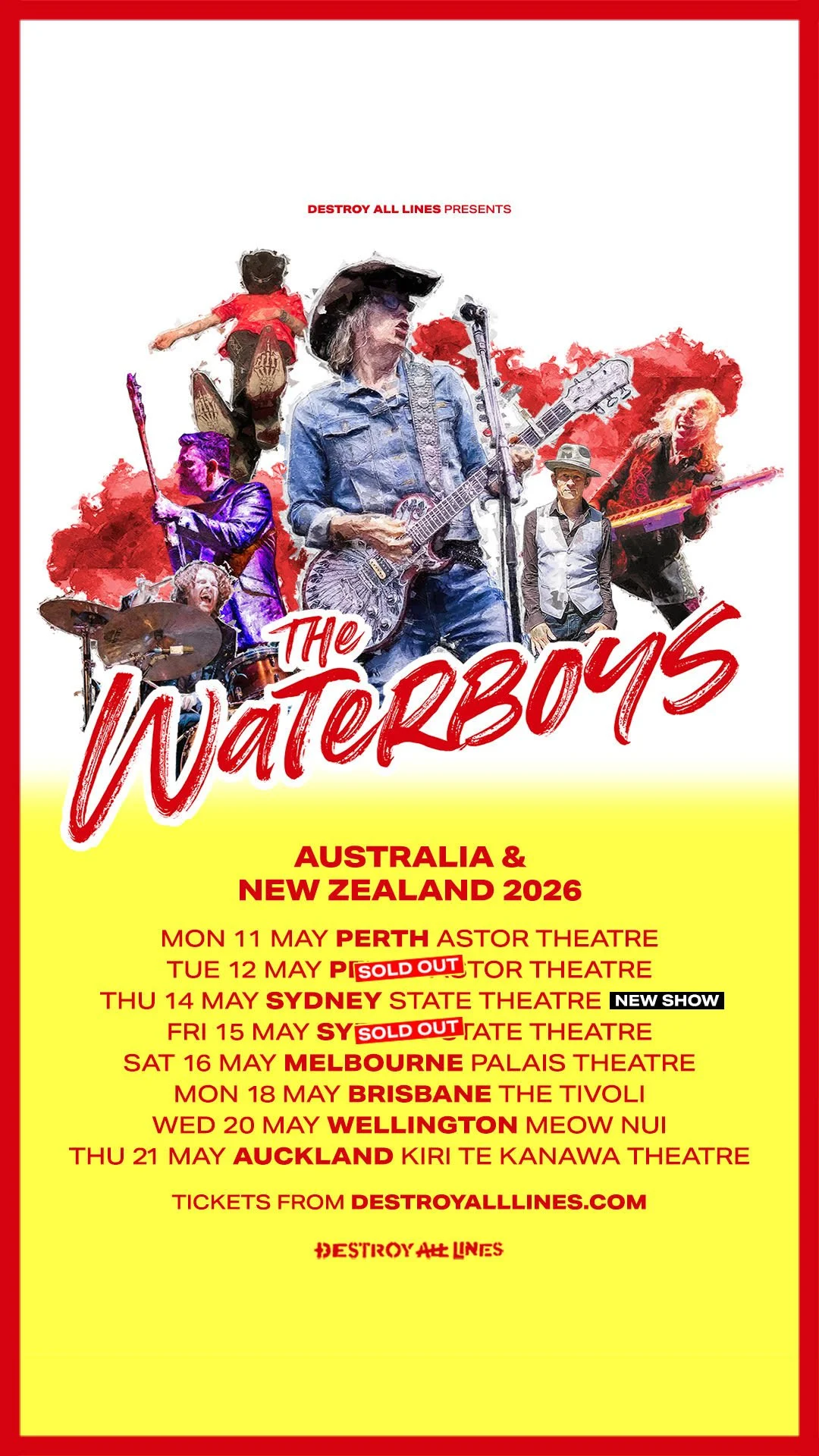
Waterboys - 2026 Australia and New Zealand Tour





Avenged Sevenfold
AU/NZ Tour 2026
Friday 23rd October- Spark Arena - Auckland
with Special Guests Coheed and Cambria & Thornhill