
Interview - Elias Soriano of Nonpoint - 28th January 2026
Elias Soriano (centre) and Nonpoint - image supplied
Nonpoint are ripping through New Zealand with their pure, unfiltered chaotic nu-metal rap-rock. Bridget Herlihy talked to frontman Elias Soriano ahead of their gig with (HED) P.E. on Friday the 13th at the Tuning Fork to find out what's new in nu metal.
Interview By: Bridget Herlihy
Interviewee: Elias Soriano
Date: 28th January 2026
It has been 29 years since nu-metal/rock band Nonpoint was formed by frontman Elias Soriano and drummer Robb Rivera in Fort Lauderdale, Florida. After the release of two independent albums in the late ‘90s, Nonpoint signed to MCA Records and released their first major-label LP, Statement, in 2000. Over the last 29 years the band has released a total of 12 albums, with their 13th just over the horizon. They have toured with the likes of (Hed) P.E., Filter, Mudvayne, Fuel, Sevendust and Papa Roach, and have taken part in major touring festivals including Ozzfest.
Nonpoint last toured Australia in 2019, but this will be the first time that the band have played shows in New Zealand. On the eve of their two shows in Aotearoa this week, I caught up with frontman Elias Soriano from his home in South Florida to wax lyrical about the upcoming tour with (Hed) P.E., releasing music independently again, and what Nonpoint has planned for 2026 and beyond.
Bridget: Nonpoint will celebrate its 30th anniversary next year, yet this is your first time in New Zealand. This tour has been quite a long time in the making.
Elias: Yeah, it is my first time. I am extremely excited about New Zealand; I'm probably the most excited about New Zealand, because I've never been, I've only seen pictures and I've only heard stories. And I'm a very, you know, I guess, traveller. I like to be awed by backgrounds, mountain lines and horizons and different colored skies and things like that. I hear that New Zealand really runs the gamut on every bit of eye candy when it comes to the environment, and I'm excited to get my eyes around it.
Bridget: Make sure that you get a window seat – on whatever flight you're taking, get the window seat.
Elias: I shall. If need be, I'll jump on somebody's lap. I don't care. ‘Excuse me, sir. What's your name again? Brian? OK, Brian, we're about to get close.’ (LAUGHS)
Bridget: How much time have you got here? Do you have some downtime to go exploring?
Elias: No, not much time. I believe we have, if I've read it correctly, we have two days off the whole time that we're there. I believe one of those days is a travel day, so probably not a lot, which is normal; that's the gig.
Bridget: It seems the anticipation is running high for both the band and the fans for your first shows here. Why has it taken so long for Nonpoint to make it to New Zealand? It seems that you have wanted to come here for quite some time.
Elias: Well, you know, there's a lot of moving parts, and a lot of trust that you put into your teams when they work for you. When they say, you know, offers aren't coming in, or it's just a little bit too expensive, it's not on budget, or we really don't have the budget to do... it's normally what we've heard. We just recently went independent a couple of years ago. So we challenged a lot of that, which is why we just did a tour overseas, and why we're coming back to Australia. It's, you know, one of those things that we needed to answer that question ourselves, and we're the best answer to that question. We trusted the people to get us over there that, you know, were put in charge of that, and it really didn't pan out for some reason. We've made our way to Australia multiple times, but for some reason we've never bounced over to New Zealand or Japan or China, or anywhere in Southeast Asia. But now that we're independent, for some reason those things are happening and they're coming through. So, you know, we're looking forward.
Bridget: Have you found that there's quite a significant difference between being independent and being signed to a record label, in terms of creative flexibility and what you can and cannot do?
Elias: You know, it's a trade. I'm going to be completely honest, because now that we've done it for some time, [when you are signed to a record label] you trade artistic freedom and mobility, and the ability to move quickly because you feel something or you felt creative, or you see a trend that you want to jump on. Those things happen faster when you're independent. Picking the song, picking the artwork. All that stuff happens way, way faster. Saying yes to something happens way faster. But the tradeoff is when you have a label that is invested in you fully, they have the chequebook. So what we've done in our independence that I think has helped us, in a sense, thrive where we should be sunsetting, you know, logistically and based on expectations.
I feel like that tradeoff for the dollar versus the speed, it's the risk factor. It's like I don't feel like something's as much of a risk, or when it pans out, it pans out, and everything's great. All the budgets are good and everybody's happy. But when it doesn't pan out and you're sitting there with the bill, it's not something like in the label game where, in a sense, I'm walking away from that invoice, even though I'm paying for it with sales and streams and those kinds of things. The majority of major label signed artists don't see those dollars until far into their career from those bodies of work. When you're independent, you see that faster. So you can fill that hole a little bit faster – a lot faster, actually. You don't wait as long. You can move a little bit faster.
But having that well of $100K available to me just in case I wanted to pull the trigger on something, in my current [independent] model, I have to get creative. And sometimes in order to make those things happen, I’ve got to tighten the belt. It's just the way it works. But the benefit on the other side we've seen is we're investing in advance and we have to wait for those profits to come in. And there's a waiting game; it's not like they come in as soon as the release happens. But it's definitely a lot less waiting than used to happen. It used to take almost a year and a half to even see a dollar – if we recouped. And getting a P&L from a label to see if I recouped, sometimes that takes six months. So how long am I waiting to get these things done? I'm blessed to have been in the position where I had an asset and we had an asset that we could leverage against in order to fund our independence in the beginning.
That folded into the machine that you see now, because we at least had the knowledge and the experience to know we need this kind of team, we need this person in place, we need an accountant, we need a person that can file everything properly, we need everything that we knew that we had. And then that's where you start to see the workload and all of those things. So there's a lot to it. But we're definitely more hands-on. We definitely move at our own pace. So there is a lot less stress in that sense. It's not just go, go, go, go, go. And also, if I drop a song and it doesn't do all that well, I'm not being put in the position any more where I'm getting looked at and going, ‘Hey, write me another record,’ as opposed to ‘Hey, there's 11 more songs on there. Do you want to maybe take a look at one or the other?’ It's that kind of rinse and repeat that's so fast on that side of the model that we don't have to deal with over here.
Bridget: It sounds very much like a double-edged sword; each model has its own distinct pros and cons.
Elias: I never know what could have happened if I was on a major label. What I do know is my experience, and my experience was the stress that I took on was worth the education. Worth the experience and worth the product. Our first song that we dropped was Ruthless, in our independence. And at the time that was our highest charting song. And we did that through independence, so we immediately checked the one box that people always say, ‘Oh, independent bands can't get into the top 20 without lots of money and a label.’ We allowed the music, our tenure and a smart marketing plan to make that happen. Once we saw that, then we decided to, in a sense, lean back, but at the same time put our foot on the gas by putting up music as much as we physically could. And that's why you saw us put out all those EPs and all that music at that time.
Bridget: The ability for the band to make its own decisions and apply creative freedom is a huge benefit to being an independent artist.
Elias: In terms of the creative freedom, that's the fun side. And getting a payday quicker than you might do through a record label. That's where touring and merchandise and the shows really, really do what they do. You know, that definitely supplements [our income] and takes care of it. And then my publishing; all my publishing that comes in from streaming and that kind of stuff.
So you write a good song and all of those other questions and all that stuff gets handled. The survival through things like format changes, going from tape to CD, CD to MP3, MP3 to streaming, sort of that rollercoaster, that takes that educational side of the business; the business of the music business. That takes being smart with that and preparing yourself for it as much as possible by making sure that you're writing music and you're releasing your artwork based on where you see the channels are going to serve you the best. That's where being smart and talking within your team, to prepare yourself for those things when you see them coming. Because we do play – it's not even playing the long game, it's just playing the game. So that business will always be a business. And the business I'm now part of will always be a business. So it's really preparing it to then eventually evolve into that. There's no end to it. My publishing, my music, my art continues to go. My daughter continues it on.
Bridget: Speaking of your art continuing on, you and the band have made some comments online teasing that there is new music coming soon. Is there a new album in the pipeline that will come to light this year?
Elias: Northern Hemisphere spring. Around spring, I'd say the first single drops. And summertime – by then, you'll have a scope of almost a majority of the record, if not all of it. And then it's just going to drop. We're getting ready for the pre-order right now. Our next release is going to be on tape, it's going to be on CD, it's going to be on vinyl, it's going to be on streaming services, and it's going to be available for download. Every format available, the record's going to be available. We've got some really, really cool items that were added to the pre-order. So we're all excited.
Bridget: Do you have plans to tour extensively on the back of the new album?
Elias: Yeah, we're already setting up a run for, I believe, this summer. The bands have already been chosen, and they're already pulling the ropes.
Bridget: And you are intending to take the tour worldwide and coming back to Australia and New Zealand and Southeast Asia?
Elias: Hopefully we'll be hitting there this year.
Bridget: With two shows coming up in New Zealand shortly, what can audiences expect to see and hear from Nonpoint?
Elias: We're bringing a lot of what we did in some of our anniversary shows and what we did over in Europe with Lacuna Coil. There were parts of both of those shows that we feel like were really, really strong and gave people more music in a shorter amount of time, since our time is going to be limited on stage because we're opening for (Hed) P.E., so it's going to be a smaller set. We want to make sure that we pack in as much as we can; some medleys, some cool parts that we plan on doing. It's going to be fun.
Bridget: You can cram a lot into 45 minutes, though.
Elias: Yeah, we plan to. We are very excited!
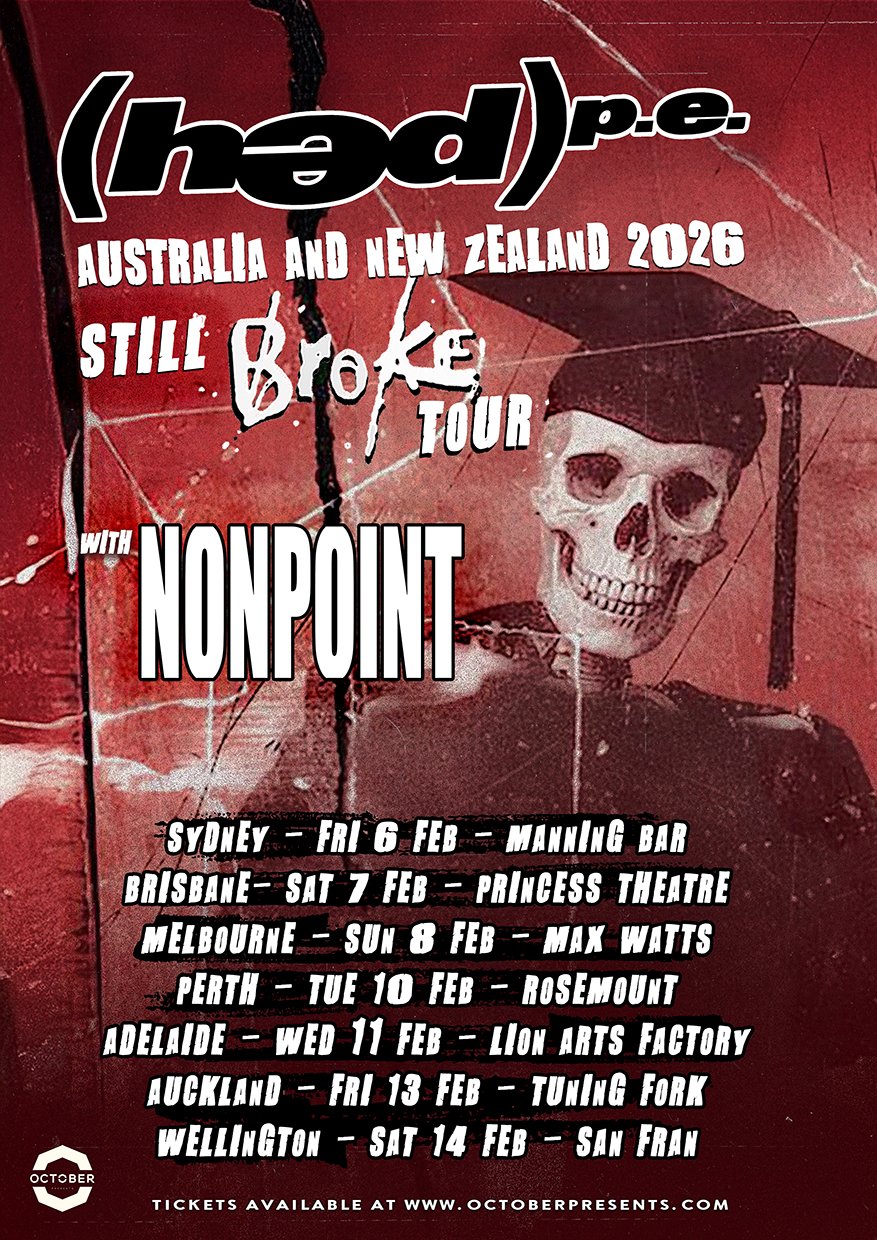
(Hed) P.E. Still Broke Tour with Nonpoint - Australia and New Zealand 2026




Avenged Sevenfold
AU/NZ Tour 2026
Friday 23rd October- Spark Arena - Auckland
with Special Guests Coheed and Cambria & Thornhill