
Interview - Brendan B Brown of Wheatus - 14th December 2025
Wheatus - 2025
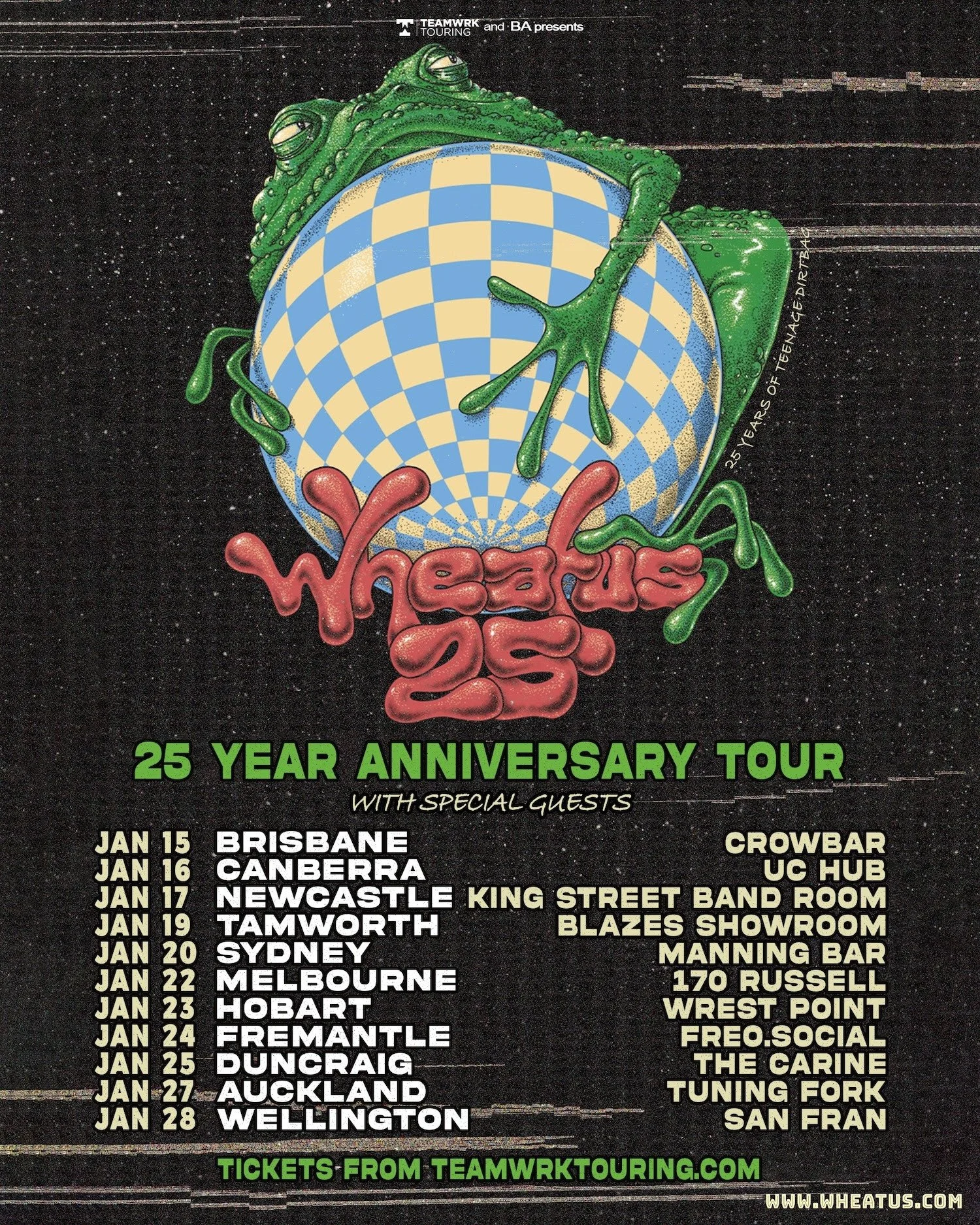
Ahead of their long-awaited tour of Australia and Aotearoa, Bridget talked to Brendan B Brown from Wheatus about the food down under, giving audiences what they want, and the lasting universal appeal of being a teenage dirtbag.
Interview By: Bridget Herlihy
Interviewee: Brendan B Brown
Date: 14 December
The history of Wheatus is fascinating. The American rock band from New York state have recently experienced a second surge of fandom, courtesy of a viral TikTok trend that uses their 2000 hit Teenage Dirtbag as its soundtrack. From their debut self-titled album, Teenage Dirtbag took months to become a bona fide hit, but once it did there was no looking back. Wheatus are by no means a one-hit wonder, having released five albums to date (one of which is a double EP). Now a whole new generation of fans have discovered Wheatus, with the band touring extensively throughout the UK and Australia, and finally making their first visit to New Zealand for three shows this week. I had the pleasure of talking to frontman/guitarist/songwriter Brendan B Brown about the band's history, Antipodean breakfast spreads and desserts, and giving their audiences what they want.
Bridget: By the sounds of it, you've got a very busy schedule with tours in the UK, Australia and NZ in quick succession to mark the 25th anniversary of the release of Teenage Dirtbag. Looking back 25 years, was it surreal to watch the song become huge?
Brendan: Well, it came after six or seven months of thinking it had tanked. It was released in the States, and it did not do very well. It kind of came and went on radio and on television. We thought that while we were playing in front of two people in Lawrence, Kansas, at the end of November there of 2000 – two people who thought we were Smash Mouth, by the way! I thought, ‘Well, that was a good run. We did all right;we put a record out. We can tell our kids that one day, maybe.’ It had come and gone as far as we were concerned at that point, and I think as far as the record label was concerned. And then, of course, we got a call about a week later,and our guy said, ‘You're going to have a number one in Australia, and you have to go down there next week.’ I think he called me on a Saturday, and it was Monday night that we had to fly out. I thought, ‘No, no, absolutely not. We're not doing that. I'm not falling for your tricks any more.’ And he goes, ‘No, no, really, this is it. This is going to happen.’ So he was right. It was number one in Australia. It did well in New Zealand as well.
We were shocked. It went from nothing happening to everything happening within 24 hours. It was crazy. I remember thinking, ‘This is great'. This is where AC/DC is from. AC/DC is my favourite rock band. I thought, ‘Maybe we can do something down here. Maybe we can become an Australian band or something.’ We were so naive, just sort of wondering how this would all pan out. And of course it was pre-internet. You couldn't just kind of Google how to be a band – which, oddly, you kind of can now. So I remember being quite apprehensive, maybe a little uptight, but also very, very excited about the potential for this to be some sort of career on whatever scale we could. And also feeling just wonderful about being in Australia. I remember this – I'll never forget that I was very, very ill when we flew down there. I'd had pneumonia on the road in the States, and it wasn't going away, and I thought, ‘I’ve got to get on a plane. How's this going to work out? It's going to be worse.’ But I fell asleep on the tarmac in San Francisco, and I woke up on the tarmac in Sydney. Even with all that sleep, it was still a rough way to go for us. I remember they brought us to the Gold Coast, and we were in a hotel on the sea there. We had come from the New York winter, mind you, and we were touring the Midwest, and it was all so wet and cold and freezing. And here I was suddenly, 48 hours later, on the Gold Coast of all places. I remember I opened up the doors on the sea side of the room and just collapsed on to the bed in my clothes, the ones I wore on the plane and the day before in New York. I slept for another 10 hours, and when I woke up breathing that sea air, I wasn't sick any more. We were so run down, and Australia came by to give us an injection of vitamin B at the very last possible second. It was wonderful. And then we were on television, and we were eating lamingtons – which I hate to say are overrated. But we did get very, very, very into Vegemite, and we still are. We're a Vegemite family. We have jars upstairs.I put loads of it on my toast.
Bridget: I'm a Marmite girl myself, and I'm a bit upset to hear that you think lamingtons are overrated. I'm quite a fan of lamingtons.
Brendan: What? Traitor! Yeah, sorry about the lamingtons.
Bridget: Did you try pavlova while you were there?
Brendan: Yeah, I did. It was all right.
Bridget: Whatever you do, don't bag that. That could be a riot.
Brendan: I quite enjoy the food down there. I mean, you guys have much better produce than almost anywhere in the world.
Bridget: Is this really Wheatus' first time in New Zealand? How is it that the band is only visiting us for the first time, given that you have played in Australia on several occasions?
Brendan: It is indeed, yeah. It was talked about every single time we went down to Australia, and somehow it just kind of fell apart. We had the wrong promoter, had the wrong blah-blah-blah. You know, something always crept up and snatched it from us at the last minute. But not this time. We're going no matter what. Everyone seems to rave about New Zealand.
Bridget: There is no doubt whatsoever that Wheatus fans in New Zealand are ecstatic that you are finally making it down here. Better late than never! It looks like all of the New Zealand shows have sold out.
Brendan: We've had an interesting year, and we're very fortunate. I feel like even if we were to lose money, we would try to come to New Zealand and just do it. We've always tried to keep our prices low and our production bare and spare and fill it with lots of well-rehearsed music, and I think that that has paid off for us over the years by reinvesting in performance and not in light shows or backing tracks or any of the stuff that's so expensive to recreate. We can show up, you know, if the PA was off, we could do it acoustic. That's how we roll these days. But I'm very much looking forward to doing the full rock show in New Zealand.
Bridget: It has been 25 years since Teenage Dirtbag dropped, and eventually skyrocketed up the music charts. I recall when it came out and it was also very popular here. It's one of those ear-worms that gets stuck in your head for hours at a time. Obviously it has had a second, or third, life as it has become iconic for a whole new generation on TikTok.
Brendan: Yeah, it keeps happening. That was a moment that I really had to just sit back and observe for a little while, because I have to confess to not having been up to date on TikTok when it began. The fad drew us into TikTok, and so we created an account and so on. But I think that what initially began as apprehension about understanding the website, understanding the app, quickly morphed into astonishment over who exactly was involved in this trend. It wasn't long before we caught the Lady Gaga one and Madonna's, and then it got into territory that really kind of shook me up. Quincy Jones did one, and I had to sit down for that. I won Thriller along with another record, Synchronicity by the Police, in 1983 or ‘84 when I was in grade school during the candy drive, selling candy bars. Those two records – I got both – and Quincy's vision and his sonic shapes are now just a part of my nervous system because of Thriller, you know? But I saw [Quincy] do it and I thought, ‘I can't believe this man knows my music. I can't believe he knows me,’ you know? And it was just one of those things that music is that unique, transient medium where you can understand the most important things about each other in that instant. He made that Thriller record and it got into me, and then something I did years later got into him. It's crazy. Nervous systems are talking to each other tangentially or whatever the word is. It's strange.
Bridget: That's a true full-circle moment. If the child who won those albums thought, ‘Hey, one day I'm going to be a musician and Quincy Jones is going to be listening to my stuff,’ it would have blown your mind.
Brendan: I can tell you that child had no mind to conceive of such a thing. And, you know, I still feel that way. The first time I saw AC/DC, I was 14, and it was [at] Madison Square Garden. I was without my parents; I had gone with some older kids, and I just remember being in the same room as Angus for the first time and just not being able to get over it. I mean, so blown away and so immensely focused on and almost trembling at the idea that we were in the same building. And I don't ever want to feel otherwise about him or any of the people who taught me how to play indirectly, you know. I've met some of my idols and worked with some of them, but I would much prefer that spooky action at a distance. You know, it's much cooler.
Bridget: Somebody said to me – maybe 20 years ago – never meet your idols, because it can be a real disappointment. I've had some good experiences, and a couple that weren't memorable.
Brendan: It can be a real disappointment. I've had both experiences. I've had mostly quite lovely experiences meeting people I looked up to, and one or two that didn't work out that way. But, I mean, you never know what somebody is going through. You know, everybody doesn't have to be friends with everybody; it's unrealistic. But I can still worship at the temple, you know.
Bridget: From what I have seen and read about the shows on your most recent tours, fans have the opportunity to interact with you. Are you going to be playing your first album in its entirety, along with audience requests?
Brendan: We open things up for audience requests from song one. Then song two, song three… We don't have a setlist. As we're setting up, I'm walking around the front row and I'm saying, ‘What's the first song? What's the second song? What do you want to hear?’ And that's how we get started. It's an exchange. It's a conversation the whole time. We haven't run with a setlist unless we needed to, in the case of maybe a festival or an opening slot where we need to time our performance perfectly. But all of our headline shows have been all requests for coming up on 15, maybe 18 years now.
Bridget: That's phenomenal.
Brendan: I find it so much easier than trying to ram a setlist down everybody's mind, you know. You don't know what kind of a day the audience has had, and in the process of getting to know what they want to hear, you're communicating what kind of mood they're in, where they are. No two audiences are the same, and if you get it wrong on that first song, you might have a bad show and they might not get their money's worth. So I would much prefer to just do what they say.
Bridget: I don't think I've ever come across, or at least I can't recall, any performance I've been to where the band has done that. On a number of occasions I've been to a show and when I look at their setlist from the last few shows and they are almost identical. There's not that element of surprise, because I already have a fairly good idea of what they are going to play.
Brendan: We have about somewhere between 54 and 60 songs ready, and we're just working them all the time. For us, believe it or not, that's a little light. We used to roll with 80 or so tracks that we could do at a drop of a hat. We love to rehearse; it's one of our favourite things to do. And, you know, you just get to a point where you're a lot more flexible on your recall of everything, your memory, your mind, your muscle memory and so on. The other thing is, it's not your show. (It's their show, right? It's [the audience's concert]. They paid. They're the ones who should get what they want. And to presume to know what that is before you've met them is arrogance, in my opinion. So setlists can go.
Bridget: That's so refreshing. What happens if somebody requests a song and you haven't rehearsed it?
Brendan: I'll tell you what, I'll walk up to the front of the stage with my acoustic guitar and I'll do it as best I can without the band. And if I get it wrong, I'll fix it and get it right, right in front of you. I mean, I know you want that. You're asking me to do that. I'm lucky to have the privilege of being able to be asked to play music for people as a living, for a living.




Avenged Sevenfold
AU/NZ Tour 2026
Friday 23rd October- Spark Arena - Auckland
with Special Guests Coheed and Cambria & Thornhill